

Hamnet (2025, Dir. Chloé Zhao):
In the 1580s, a couple living on Henley Street, Stratford, had three children: Susanna, then Hamnet and Judith, who were twins. The boy, Hamnet, died in 1596, aged eleven. Four years or so later, the father wrote a play called Hamlet.
Maggie O’Farrell, Hamnet
It’s a tale as old as time: two ordinary folks fall in love, marry against their families’ wishes, and bear and lose children, their hardscrabble lives punctuated by fleeting happiness and crushing tragedy. And yet, this particular tale is more than ordinary, for the husband isn’t just a bloke but a prodigious bard, and the death of his son isn’t just a personal tragedy but the impetus behind a work of art that is a memorial and a catharsis—a play that transcends time. But this tale is even beyond that, because it is seen through the eyes of the bard’s wife and son, mother and muse, and alongside them we acquaint ourselves with love, death, grief, anger, and acceptance.
Such is the premise of Maggie O’Farrell’s novel Hamnet, the literary equivalent of a lark. Filling in holes in history, O’Farrell speculates on the home life of William Shakespeare’s wife Anne Hathaway (named Agnes in O’Farrell’s telling) and their children, in effect giving due to players denied the stage. Will himself is an absent presence for most of the book (indeed, he is only referred to as “the father” or “the husband”) while Agnes and her brood contend with their own isolated existences. Written with feathery delicacy, Hamnet celebrates the grit, grime and grace of the quotidian, even as it paints a vivid picture of an Elizabethan England endeavoring to pull itself (literally) out of the mud.
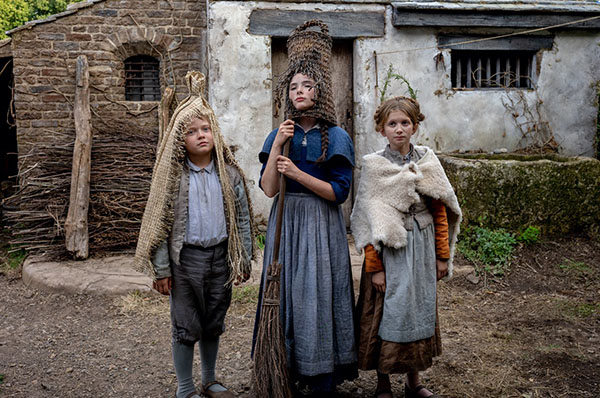
The film version of Hamnet has artier, more grandiose aims in mind. Where O’Farrell avoids overt references to Shakespearean lore in her book, director Chloé Zhao (who co-wrote the script with O’Farrell) lets the allusions fly, as life influences Will’s art and vice versa. Familiar phrases pop up at regular intervals: mentions of “undiscovered countries,” the Shakespeare children dressing up as witches to recite the opening lines of Macbeth, a character observing that “the rest is silence.” Shakespeare’s actual name might not be invoked until the third act, but it’s clear from the get-go that Will (played with off-kilter brio by Paul Mescal) is destined for great things, and Agnes (Jessie Buckley) isn’t afraid to say so: “He’s got more inside of him than any man I’ve ever met.”
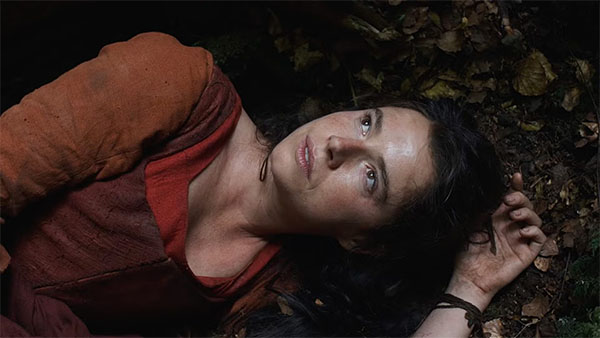
Instead of digging into the historical minutiae that underpins O’Farrell’s book, Zhao goes impressionistic with Malick-style mythmaking. Charged character moments alternate with ruminative shots of nature and civilization, as the womb-like hollows and tree roots where the witchy Agnes feels at home make way for light and shadow inside the Shakespeare clan’s drafty cottage, each painterly scene captured by cinematographer Łukasz Żal in the style of a Dutch master. Although the mise en scène is persuasive down to the dirt under the characters’ fingernails, Zhao is more invested in call-and-response storytelling in which every scrap of dialogue and detail finds an eventual payoff, whether it’s Agnes’s nature-girl upbringing (with emphasis on her knowledge of medicinal herbs, paralleling their use in Shakespeare’s plays), her premonitions of death and loss, or her twin children Hamnet (Jacobi Jupe) and Judith (Olivia Lynes) swapping clothes and identities as a joke, foreshadowing a much deadlier swap at a crucial juncture.
Love doesn’t die, it transforms.
Chloé Zhao
Will and Agnes’s initial push-pull romance is charming, as they meet cute via an explication of the myth of Orpheus and Eurydice (a scene invented whole-cloth for the movie). When Hamnet is afflicted with the plague, Zhao films his hallucinations through a black veil, as if he has already crossed over, the woods of his youth becoming both stage scenery and something more transcendent. While O’Farrell’s Hamnet devotes an entire chapter to describing the progress of plague from an African flea to the Shakespeare family, Zhou accomplishes the same exposition dump in a nifty one-minute segment using wayang puppet theatre. Theatrical flourishes like these are Zhou’s forte; she’s less successful at presenting the bustle of the everyday that informs O’Farrell’s book. All of the actors do impressive work, with Jupe a particular standout as a precocious Hamnet, but the story takes on an arid feel as it chugs from one life-changing incident to the next. Characters like Will’s abusive father (David Wilmot) and Agnes’s supportive brother (Joe Alwyn) float in and out of the story whenever a plot point needs to be resolved. Thank goodness for Emily Watson: given scant time to register as Will’s mother, she suggests reservoirs of empathy behind her disapproving gaze.
Zhao does her best to give Hamnet‘s schematic story some weight, throwing in frenzied handheld camerawork here, a stately medium-angle shot there, lingering on outbursts of emotion. In comparison to Nomadland, an immaculately composed Oscar winner that was restrained in tone, Hamnet takes some very big dramatic swings, most notably in a pair of harrowing birth and death scenes that all but wallop you on the head with their intensity. Over-manipulative, certainly, but there’s no denying Buckley (in what will likely be an Oscar-winning performance) as she runs the gamut from joy to apprehension to devastation; this is as raw as acting gets.
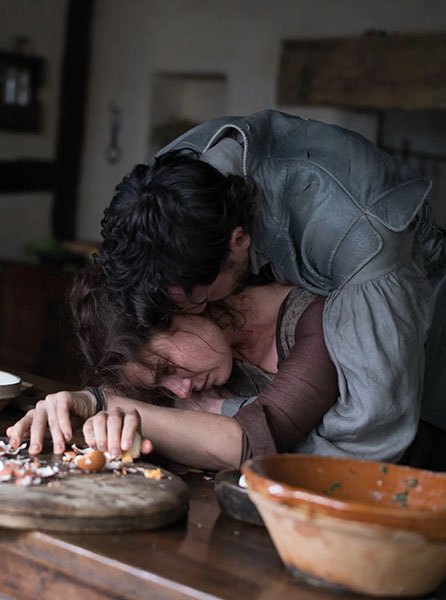
O’Farrell’s book finds its strength in its characters’ strength as Agnes accepts the fundamental truth that life goes on, come what may: “The boy has gone and the husband will leave and she will stay and the pigs will need to be fed every day and time runs only one way.” In Zhao’s take, acceptance takes a whole lot more dramatic struggle. Snapping “You weren’t there!” at Will again and again after Hamnet’s death (never mind that she encouraged Will to seek his fortunes elsewhere in the first place), Agnes works through her devastation by wrestling her husband to the floor when she’s not moping around her home like a ghost. On his part, Will goes internal and oratory, posing alone at river’s edge to monologue “To be or not to be…” in what is the film’s most inevitable and cringeworthy moment.
But if Zhou’s approach to bereavement is more performative, it’s all by design. While Hamnet may purport to be about life, its reason for being is to exalt art, as the grand finale (and ultimate payoff) finds Agnes attending the premiere of Will’s Hamlet, both of them soothing their souls through the creative process. When the play’s Hamlet (played by Jacobi Jupe’s brother Noah, a clever bit of casting) happens upon the ghost of his father (played by Will himself), Agnes shouts out the significance of the moment for those who aren’t English majors: “He’s swapped places with our son!”
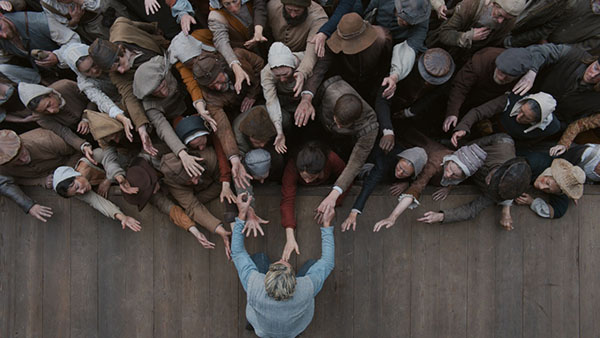
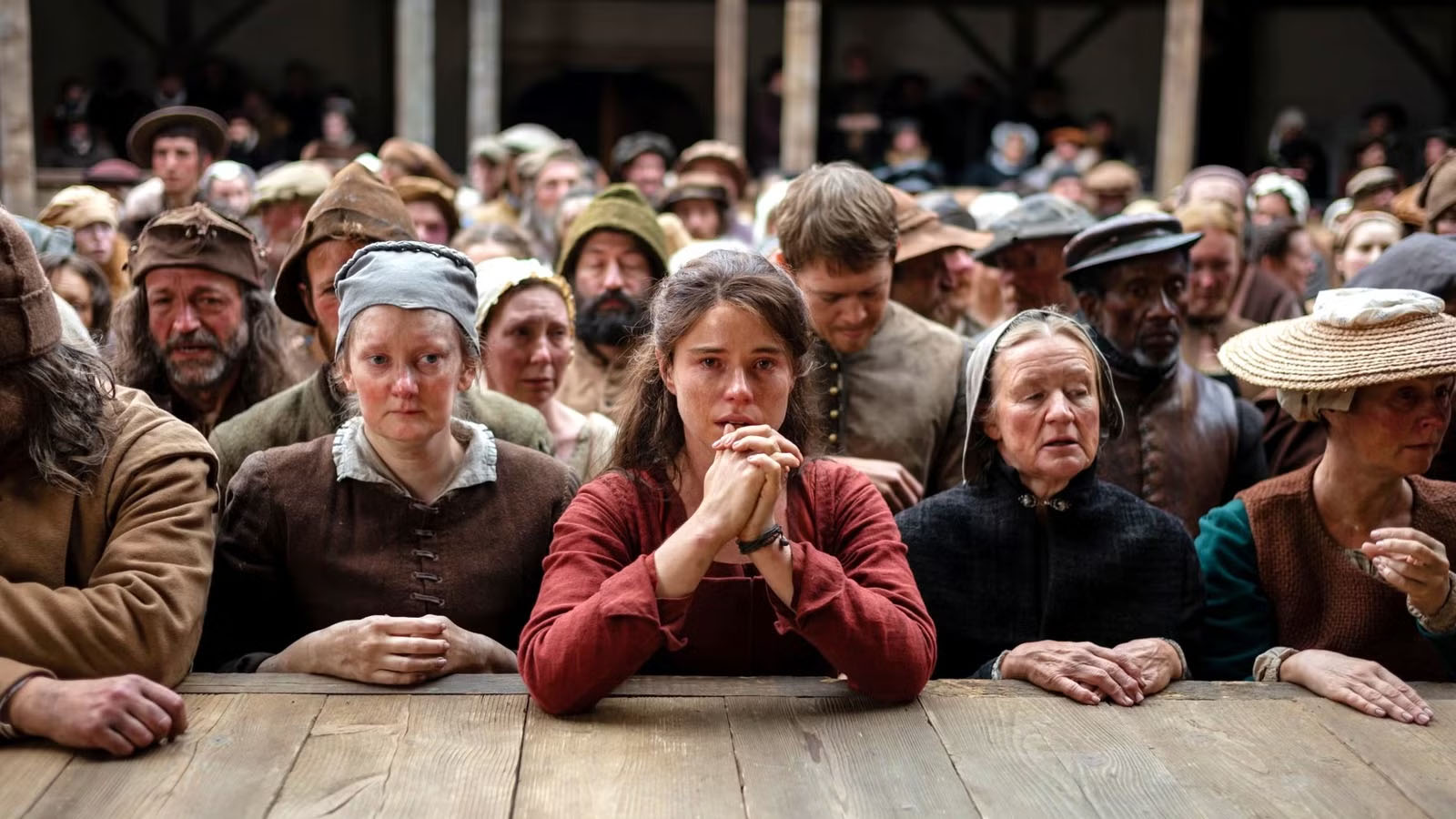
This contextual reading of Hamlet as a memorial for a dead loved one doesn’t hold up to much scrutiny; neither does the film’s presiding image of Agnes and her fellow theatregoers reaching out to touch a dying Hamlet on stage, as if her anguish has infected the groundlings like the plague itself. Nevertheless, as a piece of theatricality, one can’t deny the impact of the moment, even as Max Richter’s angelic chorales on the soundtrack command us how to feel. Zhou’s Hamnet will appeal to those who like emotions on their sleeves; others may be less moved (and it should be said that Shakespeare himself wasn’t above going hard on the heartstrings). But as an actor’s showcase and a hurdy-gurdy of emotional calls and responses, the film casts an agreeable spell—it’s no shame that it doesn’t measure up to the work of a certain master Bard who can transform sorrow into iambic pentameter. ■
