


Superman (2025, Dir. James Gunn):
I really love the idea of Superman. He’s a big ol’ galoot. He’s a farmboy from Kansas who’s very idealistic. His greatest weakness is that he’ll never kill anybody. He doesn’t want to hurt a living soul. I like that sort of innate goodness about Superman; it’s his defining characteristic. He’s not “All-Star Superman,” but again, I’m a huge fan of “All-Star Superman,” and I’m very inspired by [that series].
—James Gunn
Franchise movies becoming referendums on pop culture are nothing new, but leave it to a Superman film to take it to the next level. Not only is James Gunn’s Superman the first entry in DC Studios’ revamped superhero universe, not only does it come at a time when overall audience interest in superhero movies is at low tide, but it’s also a rebuttal (intentional or not) to Zack Snyder, who oversaw DC movies for over a decade. Pick any talking point regarding Superman and you’ll have a juicy debate, whether it’s about how Snyder’s hyperbolic, portentous take on the Man of Steel stacks up against Gunn’s (Snyder supporters have already taken their stand), whether Gunn, best known for Guardians of the Galaxy and other idiosyncratic movies, is the right man to shepherd this brave new world of DC, or if Superman can rise above our current superhero cinema doldrums (just ask Marvel how things are going).
In response to these bloated expectations, Gunn goes his own way, as usual: the familiar John Williams fanfare pops in from time to time, but this version of Superman ain’t your father’s Man of Steel. Where previous imaginings of Superman went big, Gunn’s Superman is a more downscaled affair—or at least, as downscale you can get with a film that includes pocket universes, black holes and a tear in the space-time continuum that threatens to swallow all of Metropolis. David Corenswet’s Superman (aka Kal-El and Clark Kent) might remain a pillar of virtue and rectitude, but he’s also a regular guy who enjoys a burrito, a good cup of coffee and some power-pop courtesy of the Mighty Crabjoys. He isn’t above exasperation either; often responding to irritating behavior by others with a testy sigh of “Dude” or raising his voice an octave too high, Corenswet might be the most human big-screen Supes we’ve seen yet. Just to drive home this newfound relatability, our very first sight of our hero finds him in fetal position, beaten and bloodied.
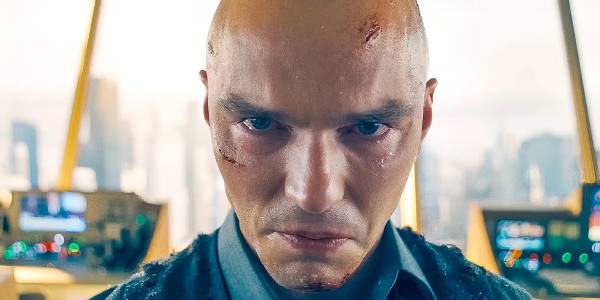
He’s not a man, he’s an ‘it’. A thing with a cocky grin and a stupid outfit.
—Lex Luthor
Gunn dispenses with origins and backstory and cuts right to the chase, expecting us to keep up: Superman is already an accepted fact around the globe, tech billionaire Lex Luthor (Nicholas Hoult) is already Superman’s A-number-one hater, Clark and Lois Lane (Rachel Brosnahan) are already a hot item, and apart from the presence of meta-humans, their world resembles our own, including conflicts between vaguely Slavic and vaguely Muslim nations. As a paragon of peace, Superman has entered the tricky sphere of foreign affairs by preempting a war between the neighboring countries of Boravia and Jarhanpur—bad news for Luthor, who’s making a killing supplying Boravia with next-gen weaponry, but the evil genius has more insidious plans in mind. When he’s not battling Superman by proxy using a mysterious super-powered being named Ultraman, he’s discrediting the caped wonder by uncovering a message from the Kryptonian’s late parents (Bradley Cooper and Angela Sarafyan) that suggests the big guy’s mission on Earth is less than altruistic. The resulting social media firestorm (aided by thousands of trained monkeys firing off nasty tweets—yes, literally) and government disapproval carries the threat of cancellation and much worse (Gunn would know—he’s been through cancellation himself). In such dire circumstances, even the most powerful being on the planet could use a little help from his friends, including Lois and the “Justice Gang” (we’re still a ways off from an actual League) of Green Lantern (Nathan Fillion), Hawkgirl (Isabela Merced) and Mr. Terrific (Edi Gathegi).
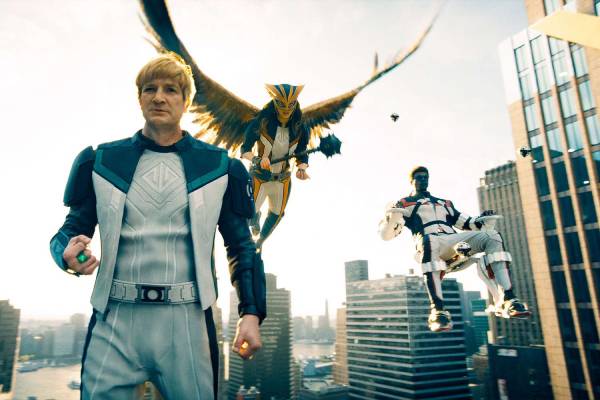
The above summary only scratches the surface of the film, which busies itself with set-up, exposition and fanciful monsters for its first half-hour while it struggles to find its groove. Gunn is most comfortable when his characters bounce off each other, most notably in an “interview” between Lois and Superman that’s both spiky and sweet. (“Superman doesn’t have time for selfies,” he says. Her response: “Did you just refer to yourself in the third person?”) But as a visual stylist, Gunn is still clunky, and apart from some arresting images of our hero in flight, his face up close and personal via a wide-angle lens, the framing and pacing aren’t a patch on the easygoing majesty that embodied Richard Donner’s Superman (1978), or even the heavy-metal grandiosity of Snyder’s iteration. Instead, Gunn stuffs the film with quips, easter egg references, and veiled commentary about current events, whether it’s our obsession with social media, the military-industrial complex or the plight of immigrants (Superman might be the most illegal alien of all). Not that these parallels to our world are well-drawn or particularly cutting; they’re only used as brief touchpoints on the way to the film’s major thesis, which is that being a good person and valuing life is as important (and essential) as ever.

Parents aren’t here to tell you what you’re supposed to be…your choices, your actions make you what you are.
—Pa Kent
Simple-minded? Corny? Yes, as corny as the Kansas fields where Clark grew up, and when Clark’s adopted father Jonathan Kent (Pruitt Taylor Vince) gives him that sunshine-sweet advice, Martha Kent (Neva Howell) even calls him out for being mushy. But it’s the emphasis on these down-home sentiments that sets this Superman apart from previous incarnations. Since his origins, Superman has been presented as a Christ-like figure, a beacon of hope, and a messiah to show humankind the way forward. Gunn takes a hatchet to that kind of Nietzschean manifest destiny: rather than serving as moral guides, Kal-El’s organic parents turn out to be toxic authoritarians who urge their son to lord over Earth and populate it with super-powered descendants. (“#Superharem” becomes a scathing hashtag in Luthor’s smear campaign.) Refuting that misguided approach, this Superman favors the preservation of life over highfalutin principles, whether that life is the food stand owner down the block, a squirrel that’s about to be squashed, or even the massive kaiju that’s doing the squashing. (Savior complexes are reserved for Luthor, who proclaims himself the “sole hope of humanity” and means it.) Superman’s “life is precious” mindset suffuses the film; death doesn’t happen often in Superman, but when it comes, it’s as sudden and forceful as a punch to the gut. Of course, the movie also has a scene in which Hawk Girl drops a bad guy to his doom in blithe fashion, but Gunn has always ridden the line between heartfelt and smart-alecky.
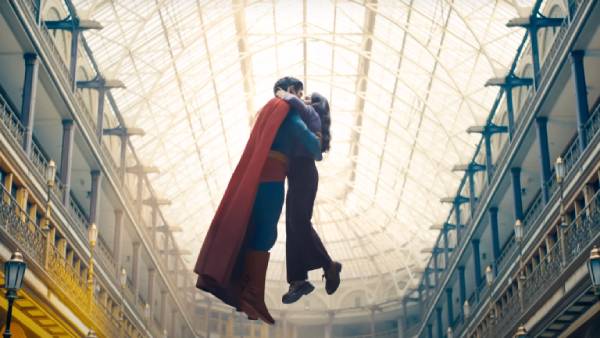
Once it gets past resetting our expectations of the character, Gunn’s Superman has fun playing in the sandbox of its new universe, opening up possibilities for storylines and characters even as it tracks Clark’s path towards rejuvenation. Its milieu of “gods and monsters” harkens back to Silver Age DC comics, but the focus remains squarely on human qualities: Brosnahan is appealing as a feisty Lois, Fillion has a blast injecting his Green Lantern with smarmy self-regard, Anthony Carrigan is disarmingly vulnerable as the shapeshifting Metamorpho, and Gathegi gives good growl as Mr. Terrific, coming on like a high-tech Shaft. Even Jimmy Olsen (Skyler Gisondo), often depicted as a gee-whiz dweeb, gets to be the hero of his own story as he romances Luthor’s mistress Eve Tessmacher (Sara Sampaio) for critical information. As Luthor, Hoult is a perfect foil to Corenswet’s Superman: snappy and sociopathic one moment, wounded with envy the next. If Clark is the corn-fed good guy of our dreams, then Luthor is the hip incel nerd of our nightmares, imprisoning ex-girlfriends in pocket universes when he’s not having hissy-fits and plotting to take over countries and governments. Even when the movie goes big for the climax, Gunn isn’t as interested in the expert deployment of CGI as he is in the look of desolation on Hoult’s face when Superman messes with his plans one more time, or the sight of Clark and Lois engaged in a passionate clinch even as they wonder if this human-superhuman romance thing will work out in the end.

Gunn’s Superman isn’t the most elegantly assembled piece of pop art you’ll ever see, and it likely won’t win hard skeptics to its cause, but in its shambling way, it proclaims itself as nothing more than what it is: an entertaining superhero flick. If the movie has a spirit animal, it’s Kal-El’s pet dog Krypto—like the film, Krypto is rambunctious and unruly yet eager to please, and he gets most of the movie’s big laughs, reminding us that for all its musings on life and purpose, we’re watching a comic book movie after all, which means it’s okay to have elements like super-powered, super-goofy dogs. Speaking of super, the movie concludes with a cameo by a certain blonde cousin (played by Milly Alcock) who calls Kal-El a bitch (affectionately, of course), further hinting at a future course for DC Studios that privileges amiability over grandeur. Whether amiability will be enough to power DC’s next batch of movies to success remains to be seen, but taken on its own, Superman is a brisk, breezy palate cleanser that pulls off the neat trick of reinventing its cinematic universe as well as its title character without making a huge fuss about it. ■
