

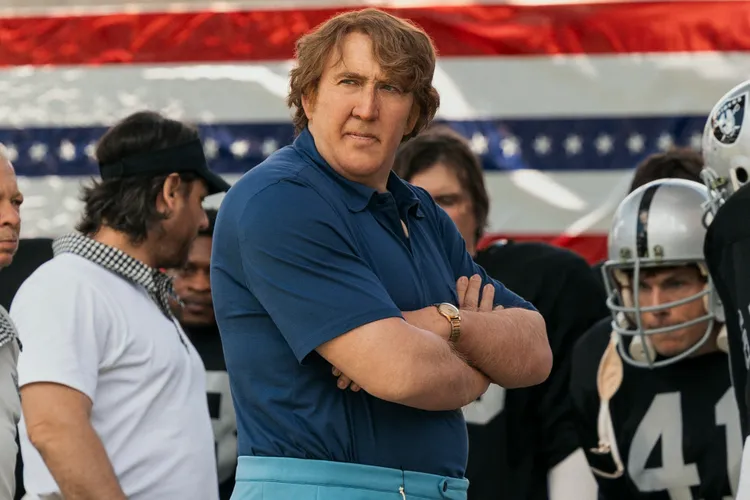
Madden (2026, Dir. David O. Russell)
Any follower of the NFL in the ’80s and ’90s knows who John Madden was—or at least, what he represented. A floppy, enthusiastic golden retriever of a TV commentator, Madden made football approachable for audiences every Sunday, breaking down plays with a mix of smarts and cockeyed wit. While most remember Madden for his impromptu “pow”s and “boom”s and “whap”s that accompanied replays of textbook tackles and blocks, I tend to recall his daffier moments: circling a trio of Gatorade buckets on his telestrator, suggesting the “Daddy” and “Mommy” Bucket birthed a “baby” bucket, or attempting to explain how power equals mass times acceleration (my high school physics teacher, a fellow New York Giants fan, sighed in class the next day that John was all wrong—that was the formula for force, not power).
Madden’s outsized persona was also perfect for the cultural phenomenon that was (and is) his namesake: EA’s Madden Football video game. His presence on the cover and in the actual gameplay certified that this was the real, unadulterated thing, making good on the packaging’s claim that everything one would expect from the NFL was “in the game.” Madden’s specific quirks—a fear of flying that led to him traversing the country in a custom-built “Maddencruiser” bus, his obsession with Turduckens, his ability to hawk everything from Miller Lite to Tinactin with affable glee—only added to his stature as a American icon who appealed to all demographics. He was a buddy you could envision sharing a beer with at the bar, an ambassador for the most violent sport in the land who treated it as a romp rather than a life-or-death proposition, a lovable bear, a born entertainer.
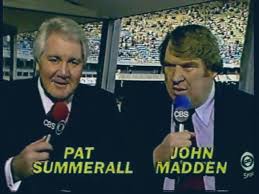
Behind that sunny exterior was a more complicated figure. As head coach of the Oakland Raiders in the ’70s, Madden drove himself into emotional and physical hell, and early retirement. While his enthusiasm for football was genuine, he was also way more erudite than he let on. Behind his freewheeling patter was a thoughtful, academic approach to the game: days spent teaching football to college students at Cal Berkeley helped him craft and hone his shtick so that he could communicate with casual viewers without dumbing things down for them.
All of the above is to say that John Madden was a fellow with unique qualities—none of which comes across in David O. Russell’s Madden. Russell presents Madden’s life as a cavalcade of pseudo-comic vignettes, each milestone dutifully addressed: Super Bowl win in 1977, burnout and retirement, the unlikely return to prominence as half of the best broadcasting duo ever assembled alongside Pat Summerall (Joel Murray), recruitment by EA wunderkind Trip Hawkins (John Mulvaney) to be the face and guts of the Madden football game. Every so often the potential for something juicy arrives—the sight of Raiders defensive end John Matusak (Watts Dantzler) brandishing a gun at his teammates, or Madden rubbing shoulders with Howard Cosell (Rick Hoffman) and Bob Costas (Connor Price) during his initiation to broadcasting—only for Russell to do nothing with it. Drably lit and shot (by Oscar-winning cinematographer Robert Richardson, no less), nothing from the movie registers, let alone lingers. Russell tries Scorcese-ing it up with lightning edits, characters addressing the camera and period-correct soundtrack cuts, but where his whirligig approach fit the coked-up antics of American Hustle, in Madden it can’t camouflage the black hole at the heart of the narrative: Madden himself.
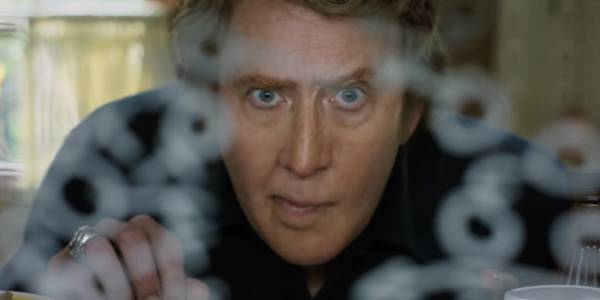
In previous films like I Heart Huckabees and Silver Linings Playbook, Russell had fun with neurotics driving themselves (and each other) crazy, and he must have seen similar potential in Madden’s savant-like fixation on football. But with a script (co-written by Russell) that substitutes archness for insight and characterizations that veer towards the farcical, any sort of appeal the movie earns rests on the shoulders of the man playing Madden, and sadly, Nicholas Cage is all wrong for the part. His molasses-slow delivery comes close to capturing Madden’s inflections about fifteen percent of the time; otherwise he plays him as a near-autistic basket case, mumbling plays to himself, a total lug when he’s not on the field or in the broadcast booth. So much footage of the real Madden, vital and engaged on and off the sidelines, is ingrained into our collective consciousness that it’s near-impossible to match Cage’s dazed performance, not to mention his jowly makeup and mop-like wig, with the genuine item.
The other actors, playing it broad, don’t offer much help. In the thankless role of Madden’s wife, Kathryn Hahn gets in some gutsy line readings, and Mulvaney almost works himself into a comic lather as Hawkins, while Sienna Miller is mere set decoration as the wife of maverick Raiders owner Al Davis (Christian Bale). The less said about Jamie Gillis as Madden’s next-door neighbor (a purely fictional invention out of a C-grade sit-com), the better. Even the attempts at meta-humor are strained: former Raider running back Marshawn Lynch shows up as a geeky EA employee, but is given nothing funny to do, as if his presence alone should be a barrel of laughs.
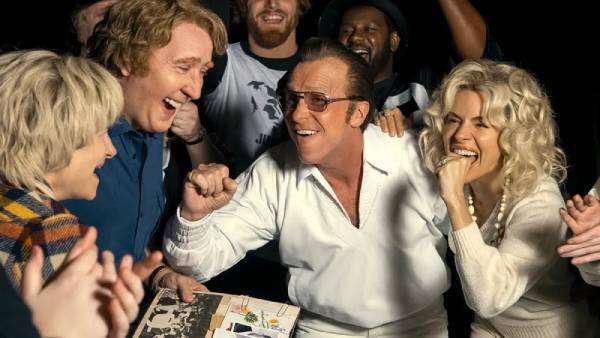
The movie only approaches genuine conflict during Madden’s back-and-forths with Bale’s Al Davis, the former inarticulate and addled with X’s and O’s, the latter firing off “commitment to excellence” and win-at-all-costs slogans at every turn as he tries to convince Madden to stick with the Raiders. Bale’s Brooklyn accent and ridiculous hairline flirt with parody but he captures something of the real Davis’s give-no-fucks attitude. Truth be told, given Davis’s mammoth personality—the braggadocio, the combativeness, the hubris, his tendency to be compassionate one moment and vindictive the next—one can imagine a more involving picture centered on Davis’s life, with a more restrained Bale in the lead. Of course, one could probably do just as well with a viewing of NFL Films’ “A Football Life” episode on Davis.
In the end, Madden ignores the one ingredient that makes sports worth watching: an actual object to the game. Too breezy to dig into the stratagems that thrilled the real Madden, too content to idle away while its characters bicker and blunder from moment to moment, the movie is an inert pastiche that struggles to say anything of consequence. Watching it is like watching a crew of improv actors who have never even looked at a football being asked to huddle up and scheme their way to a touchdown from 99 yards away; the results are ghastly, and not in an entertaining 1976 Tampa Bay Buccaneers kind of way. ■
