

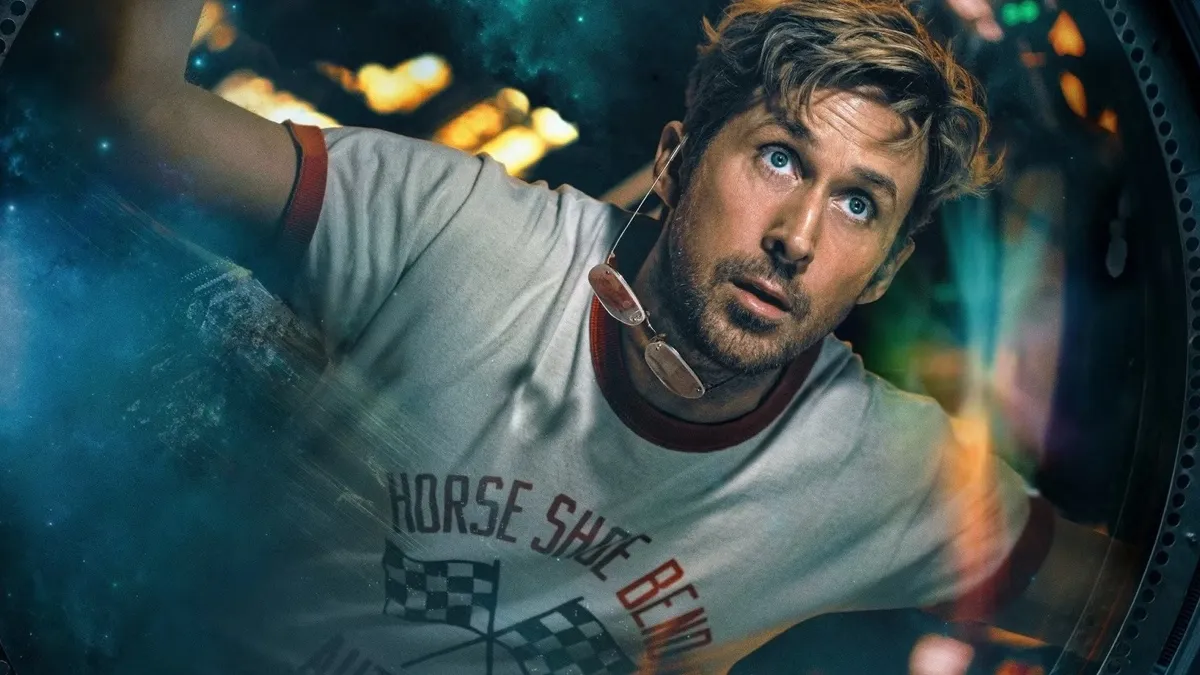
Project Hail Mary (2026, Dir. Phil Lord and Christopher Miller):
“You’ve had years of direct training. You know the ship and the mission inside and out. And you’re a world-leading expert on Astrophage… You know how I operate, Dr. Grace. More than anyone else. I want to give Hail Mary every possible advantage. And right now, that’s you.”
I looked down at the table. “But I…I don’t want to die….”
“Nobody does,” said Stratt.
Andy Weir, Project Hail Mary
Andy Weir’s novels can be summed up as the Revenge of the Nerds: not the kind of nerds who camp out at Comic-Con or beef with each other on X over whether their favorite entertainment franchise was better in the old days, but honest-to-goodness nerds who can calculate on the fly how much distance and time it takes for one spaceship hurtling at an obscene speed to rendezvous with another spaceship moving at an equally ludicrous velocity. In Weir’s stories, impossible challenges are surmounted not through charisma or guts or brawn (although those have their uses) but by consistent application of our little gray cells, and in contrast to anti-intellectuals (which is pretty much everyone these days) Weir actually has faith in humankind’s ability to rise above our circumstances through science and smarts. Small wonder that his books and their mix of the analytical, the suspenseful and the optimistic make for lively cinematic experiences, and while it’s true that most nerds don’t look like Matt Damon and Ryan Gosling, chalk it up to standard Hollywood operating practice: draw in paying customers with a hunky lead and then hit them with heady concepts and scenarios based on science fact rather than science fiction.
In outline, Project Hail Mary shares similarities with Weir’s The Martian (2015): a spacefarer isolated far from home, with nothing to rely on but ingenuity. But while The Martian is the story of a single man’s struggle to get back home, like a solar system-spanning version of Robinson Crusoe, the stakes are way higher in Hail Mary. In short, the sun is dying and Earth’s entire population is in peril thanks to newly discovered energy-sucking organisms called Astrophage. The only shot at survival is to investigate a far-off star where Astrophage seem to have no effect; the catch is that the ship has only enough fuel for a one-way trip. Suicide mission, in other words, and smart-alecky Ryland Grace (Gosling), the scientist who discovered Astrophage, is happy not to participate (“I put the ‘not’ in ‘astronaut’!” he protests). But when tragedy forces him to join the mission, it sets off a series of events which results in Grace all alone in the good spaceship Hail Mary, the entire weight of Earth’s future on his shoulders. (Hail Mary, full of Grace—get it?)
Weir’s book is packed with all sorts of scientific derring-do as an amnesia-addled Grace comes to grips with his situation and engineers himself out of one scrape after another. The film opts to compress that portion of the narrative in order to get to the meaty stuff: aliens! In a surprise twist (at least, it would have been surprising if the trailer didn’t give it away), Grace comes across a spaceship from the 40 Eridani star system, and after a tense yet amusing exchange of greetings (served up message-in-a-bottle style), he meets Rocky, a quirky, lovable extraterrestrial who’s shaped like a spider and expresses himself in mellifluous rumbles. (Cue jokes about the Rocky movies.) Like Grace, Rocky is a sole survivor whose planet depends on a solution to the Astrophage riddle, and as the two come to work together and bond over memories of significant others, the proper way to give a thumbs-up, definitions of sleeping and dying, and eating habits, Hail Mary reveals itself to be a buddy movie, a two-hander (or two-mandible, if we want to be accurate about Rocky’s appendages) in which any chance our world has depends on the power of friendship.
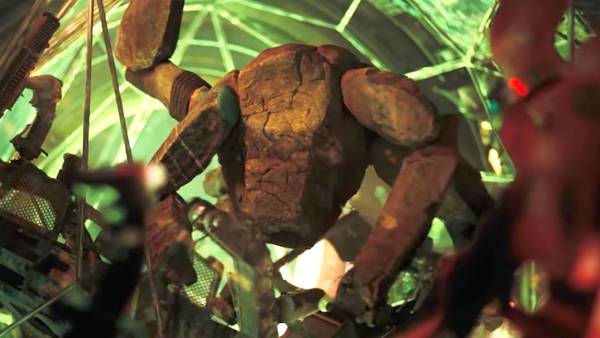
Rocky: How do you know when the hug is done?
Grace: You just feel it.
Rocky: Oh, are you feeling it now?
Grace: Nope.
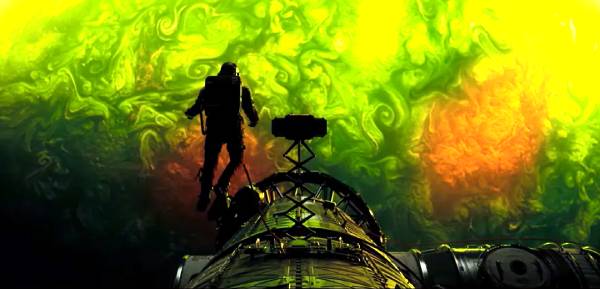
All of this has the potential to be silly and sappy, but directors Phil Lord and Christopher Miller of Lego Movie fame are too quirky for that; they know how to keep the mood light and the pace percolating. Just as Grace and Rocky skip the Hail Mary across the atmosphere of a forbidding planet, the movie skirts the border between heartfelt and irreverent, with fresh crises erupting whenever the mood threatens to get saccharine. Effects-wise, the movie slow-plays the spectacle (the interior spacecraft scenes were filmed with practical backdrops outside the windows rather than CGI), but the big moments—a visit inside Rocky’s spaceship that has a Spielbergian sense of scale, a fly-by of a planet that pulses with a swirling atmosphere of watercolor greens and reds—are as wondrous as any sci-fi movie in recent memory.
Carrying the movie on his shoulders much like his character carries Earth’s fate, Gosling does what he always does: a self-deprecating wisecrack here, a dewy release of emotion there. As an actor he’s always been in on the joke when it comes to his super-good looks (e.g., Barbie), and if his Grace is the dreamiest scientist imaginable, he at least brings a healthy amount of self-doubt and exasperation to the character. His tuned-in yet relaxed performance isn’t a major stretch for him, but it suits the film’s chummy vibe, as do his interactions with Rocky (voiced by James Ortiz, who’s also the puppeteer behind Rocky), which range from sincere to thorny. “Fist my bump,” says Rocky at one point. “No. It’s fist bump,” retorts Grace. “Is same,” insists Rocky. “It’s not the same,” sighs Grace. (Of course, “fist my bump” is trotted out later in the film at a crucial crowd-pleasing moment.)
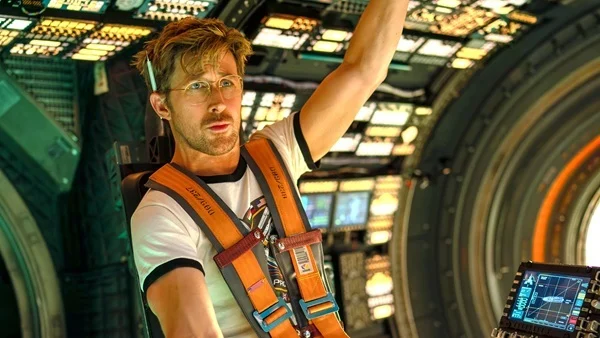
While The Martian is all about “science-ing the shit” out of its hero’s predicaments, Project Hail Mary privileges feel-good vibes over brainy dramatics. This often works to the film’s advantage—even an otherwise humorless administrator like Sandra Hüller’s Eva Stratt gets the benefit of a humanizing moment when she sings karaoke to Harry Styles’ “Sign of the Times”—and sometimes to its detriment. The final act rushes into a major crisis without much build-up or payoff, and when it’s not assaulting us with thunderous choirs, Daniel Pemberton’s happy-go-lucky soundtrack all but assures us that things will be okay in the end, diminishing the suspense. Hail Mary might be the coziest “fate of the Earth at stake” movie ever, but the approach seems to be just what audiences need, given the film’s massive success so far. The equivalent of a cosmic greeting card with a few puns in the text, the film is a throwback to classic Hollywood cinema in which a positive attitude and can-do spirit overcome all obstacles, which might not be such a bad message in these troubled times. Triumph of the Nerds, if you will. ■
