For those desiring a smidge of realism in their spy stories, John le Carré has long been the corrective to the likes of James Bond and Jason Bourne. You don’t pick up a le Carré novel to read about men of action, even though such men do exist in his world— typically, they’re the ones hung out to dry by the spymasters who are the real string-pullers. Heavy on labyrinthine plotting and intellectual acrobatics, his tales are worlds away from mainstream spy cinema, which concerns itself with government spooks who act like glorified stuntmen, and stories which get as complicated as “nab the secret doodad before the bad guys.” Still, something about le Carré’s work has never quite gone out of style with filmmakers. Maybe it’s the sheer gamesmanship on display, so closely mirroring the smoke and mirrors of any movie production, or perhaps it’s his stories’ acknowledgment that no one who dirties their hands ever gets clean, which matches our eternal cynicism about our nations and corporations.
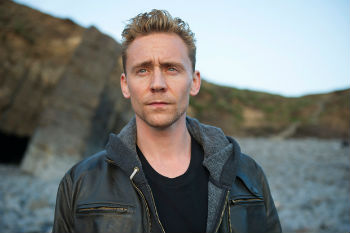
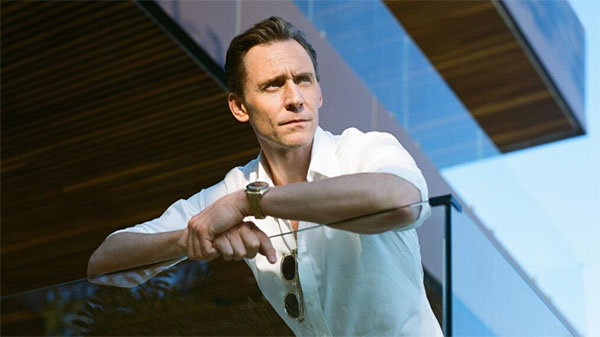
Since the Cold War came to a crashing halt, le Carré’s plots have settled into a familiar groove: a civilian of questionable compunctions and certain skills is drawn into the espionage game, with reliably disastrous results for all parties involved. Writer David Farr’s six-episode miniseries adaptation of The Night Manager, le Carré’s first post-Cold War opus, follows the outlines of this template, but Farr and director Susanne Bier have different aims in mind. Other recent cinematic adaptations like A Most Wanted Man and Tinker, Tailor, Soldier, Spy have doggedly clung to le Carré ‘s depiction of a gray world inhabited by monkish schemers deliberating over their moves like chessmasters, with hapless humans standing in for pawns. This time around, the filmmakers want us to have a little more fun. Most surprising of all, we’re meant to buy into an honest-to-goodness hero: Jonathan Pine (Tom Hiddleston), a British Army vet who spends his days concierge-ing about in swank hotels. Like Lawrence of Arabia (whose memoirs occupy a prominent place on his bookshelf), Pine is a man of talents but no practical way to utilize them, save for keeping a cool head for the high-paying customers in global flashpoints such as Cairo at the height of its Arab Spring.
Pine’s routine gets a shake-up when Sophie (Aure Atika), the comely mistress of a Egyptian kingpin, approaches him with some classified arms trade documents that point the finger squarely at Richard Roper (Hugh Laurie), the seemingly benevolent CEO of a multinational manufacturing firm. Sophie provides the Cliff’s Notes version: “He’s the worst man in the world.” Fueled by chivalry and lust, Pine forwards the documents to the British embassy, and they eventually find their way to frumpy Secret Service operator Angela Burr (Olivia Colman), who has been tracking Roper for years despite the studied indifference of her superiors. When Pine’s dalliance with Sophie ends in tragedy, Burr seizes on his guilt and desire to do some good to draft him as an off-the-books agent. “There is half a psychopath lurking in there, Jonathan,” she exhorts him. “I want you to find him and stick to him.” Pine’s assignment: Infiltrate Roper’s inner circle and find enough evidence to nail him for good.
“Becoming a man is realizing it’s all rotten. Realizing how to celebrate that rottenness… now that’s freedom.”
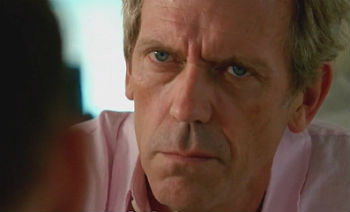
So far, so le Carré. But instead of the standard subdued approach, Bier openly courts comparisons with nothing less than the James Bond films (indeed, she’s thrown her hat into the ring to be a future Bond film director). As Pine’s pursuit of Roper takes him from Cairo to the Swiss Alps, Mallorca, and Turkey, Bier luxuriates in the travelogue sweep and sun-drenched sexiness that used to be the sole domain of Ian Fleming. These characters aren’t just ruthless — they’re immaculately tanned and tailored, to boot. Laurie’s Roper has an island getaway befitting of a Bond villain, and indeed, he’s the best Bond villain of the past four decades: a charismatic scowl glued to his face, witty and rotten to the core, he makes for a delightfully venal antagonist. The series’ score by Victor Reyes, packed with singing strings and ominous contrapuntal horns, is a clear nod towards John Barry‘s work. Even the title sequence, with its cheeky imagery of cluster bombs arcing into the shape of a pearl necklace and tea sets morphing into Gatling guns, is out of the 007 playbook.
Perhaps we can tie all this Bond-osity directly to Hiddleston. Not surprisingly, he’s the oddsmakers’ favorite to become the next Bond based on his performance, which seems like nothing less than an audition for 007. No monkish intellectualism here—like Her Majesty’s favorite secret servant, he gets to bed several women through the course of the narrative (but with more “No please, I can’t—oh all right, then” sensitivity), and he’s completely at ease chatting up the locals in the native tongue, or ordering a martini in a casino. Of course, there’s also a distressed damsel in the form of Jed (Elizabeth Debicki), Roper’s kept woman (“I went to New York to buy a painting, came back with her,” Roper gloats). While her backstory is boilerplate, Bier allows her enough humanity to make her more than a token plot device. More memorable is Roper’s right-hand man Corky (Tom Hollander). An alcoholic homosexual who is equally as jealous of Pine as he is protective of his boss, his character is about as retrograde as it gets, but Hollander’s performance, all brusque, bitter menace, stands out. Colman comes off the best, which is no surprise given her CV, which includes Broadchurch. Even though Burr in the Night Manager novel is a man, she’s as good as anyone since Alec Guinness in playing the classic le Carré protagonist: the dyspeptic, underappreciated middle manager afflicted with a conscience, who can strategize with the best of them. For all the series’ emphasis on luxe trappings and glamorous people staring each other down, its standout moment comes when the shabby-looking, very pregnant Burr rifles through a man’s hotel room while a burly thug fast approaches.
For its first few episodes, The Night Manager engrosses: Bier works up a fine mood of danger and intrigue, and Hiddleston’s initial scenes with Laurie, the two men trading icy bonhommie, crackle with tension. Meanwhile, in juicy passages back in le Carré’s happy hunting ground of dreary old London, Burr faces off against moles and bureaucrats within the Secret Service hierarchy. Times may change, but le Carré’s worldview remains the same: the worst atrocities are those committed with clenched smiles, inside burnished government offices. Where it all starts to go wrong is when Pine worms his way into Roper’s gang, which mirrors the novel’s major flaw: Why would Roper, a paranoiac with airtight security, allow a complete stranger into his operations, and then not immediately distrust the stranger as soon as shit starts hitting the fan? The Night Manager might be a riff on Kurosawa’s Yojimbo and even the Bond film Licence to Kill, but for the central deception at the heart of it to work, one must take time to show the con in action: the ferreting out of an opponent’s weaknesses, suspicions ignited and deflected, the combination of sweat and smarts needed to see things though. Bier and Farr have neither the rigor or interest to get into all that, so instead we have Pine and Roper pal-ing around in silk shirts and tailored jackets, and within a couple of episodes Pine is Roper’s trusted linchpin for his biggest arms deal yet. You’ll find more plausibility in the plot of Moonraker.
Once we lose our suspension of disbelief, the rest of the series falls apart like a house of cards. We’re meant to see Roper and Pine as two sides of the same coin, both men capable of duplicity to get what they want, but can we buy Hiddleston’s Pine as a slippery counter-agent? As a reluctant romantic hero, Hiddleston gives good smolder, but little in his performance suggests the “psychopath” that Burr sees in him — not that the script affords him many opportunities to be cruel or crafty. While he may have the breeding of a James Bond, he’s too puppy-ish to convince as a hard case, and for the duration of The Night Manager, he ping-pongs between two modes: pensive and ingratiating. Matched up against a heavyweight like Laurie, he’s strictly bantamweight. Bier tends to be clunky with plot, and such is the case with this series, as the story frays the longer it goes, the villains behaving more and more like idiots. For a while you might think that there’s a twist coming, that Pine is being played as much as Roper, and indeed, in le Carré’s novel (spoiler alert), the hunter and the hunted exchange roles at a critical moment. No such luck with this adaptation though, as everything is wrapped into a neat little bow. It turns out that Roper is as clueless and careless as he seems to be, villains are properly foiled, our heroes get a good measure of justice and revenge, and everything winds down to a satisfactory ending which should go over well with general audiences, but is antithetical to the point of a le Carré novel. It should surprise no one that the original conclusion of The Night Manager is far more Pyrrhic in nature: while a few innocents may be spared, evil marches on unabated, and those in the corridors of power who attempt to fight it end up crushed under the boot of political expediency. Bier’s The Night Manager is too busy getting high on the fumes of its own glamour to get anywhere near that dirty, and the result is even less sincere than a Bond film. At least 007 has the good grace to treat everything like a lark; The Night Manager pretends to be as intelligent and sophisticated as the finely fitted suits its characters wear, in the hopes that you won’t notice the absurdity underneath.
The Night Manager Season 2 (2026, Dir. Georgi Banks-Davies):
In a world where TV sequels sprout like weeds (and often deserve to be cut off at the roots), the second season of The Night Manager comes as a surprise. The late John le Carré’s original novel was a standalone work, and any attempt to restart the series would have to depend on a story written from scratch—and who would be foolhardy enough to take on that challenge? Not to mention that Season 1 is already a decade in the rear view mirror, an eternity in TV-land. But streaming TV plays by its own rules, especially when there’s an opportunity to re-milk existing properties, so here we are, ten years later, with Amazon and writer David Farr re-immersing us in espionage, political power plays, sexy evildoers, and Jonathan Pine right in the middle of it as the world’s most worried spy, embedding himself anew in a terrorist group, wondering if he’ll lose his soul, but not really, because after all, he’s played by Tom Hiddleston.
Back on the case: Jonathan Pine (Tom Hiddleston) scopes out his quarry.
Season 2 takes a while to get its groove on and maneuver players into place; the first two episodes in particular are a pale echo of what has come before, as Pine jets off to Barcelona and then Colombia to investigate a major arms deal. The story makes gestures towards the luxe vibes of the first season, especially when Pine enters an almost-not-quite-but-maybe love triangle with charismatic crime lord Teddy (Diego Calva) and his slippery moll Roxana (Camila Morrone), with Hiddleston and Calva striking homoerotic sparks. But director Georgi Banks-Davies is more stolid than stylish, and the production bears the stamp of a standard Amazon product: meat-and-potatoes framing, disinterested wide shots of far-flung locales, electromagnetic super-weapons. For a while it feels like we’re watching a Brit-inflected Jack Ryan—the sort of brawny anonymous thriller that le Carré would turn his nose up at.
Imagine a ménage à trois: Pine (Tom Hiddleston) gets hot and heavy with Roxana (Camila Morrone) and Teddy (Diego Calva).
But then the series takes what looks like a catastrophic twist (Teddy turns out to be the bastard son of Hugh Laurie’s Richard Roper from season 1) and stands it on its head with the unexpected arrival of Roper himself. The “worst man in the world” is very much alive and well after being left in a precarious position at the end of season 1, and with his reappearance, the story clicks into place as a series of confrontations and counter-moves. Farr might not be as adroit with plotting as le Carré but he’s well-versed in the themes that run throughout le Carré’s work: imperialistic ambitions in benighted third-world countries, rot that extends all the way to top government circles, bad people with all too-human foibles, the uneasy secrets of lovers and parents. All these motifs get their moment as the narrative ping-pongs between the chilly streets of London and the treacherous Colombian jungles, Pine playing Teddy and Roper against each other like a maestro, once again proving to be a smooth operator. If Hiddleston is more comfortable being sweaty than steely, he has the good grace to let the other actors chew the scenery, and Laurie and Calva helpfully oblige.
Season 2 is less cerebral and seductive than season 1, but it’s also a more honest representation of the le Carré experience, in which innocents become collateral damage, and the rich and powerful are too big to fail. Structurally, it’s a riposte to the sunny derring-do of Pine’s first adventure, as established tropes get flipped upside down. Roxana might seem like a damsel in distress similar to Elizabeth Debicki’s Jed but she’s also a hardened realist more apt to betray Pine than jump into bed with him, while Angela Burr (Olivia Colman), a paragon of virtue in the previous season, turns out to be a diminished, compromised figure in season 2 (sadly, Colman is barely a presence due to scheduling conflicts with other projects). If Roper seemed like an over-trusting dolt at times in season 1, there are no illusions here; his head shorn to a buzz cut, framed by a wolfish beard, Laurie is more guarded and reptilian than ever, and the season concludes with his character in the ascendant, as he turns the tables on Pine and his do-gooder colleagues.
Evil in the ascendant: Hugh Laurie returns as Roper in “The Night Manager” Season 2.
I pride myself on being an adaptable man. When circumstances demand it, I shed a skin and pick up a new one.
Richard Roper
Packed with incident rather than intrigue, The Night Manager‘s second season hinges on some unlikely turns, capped with a shockingly bleak denouement. One could be cynical and see this as standard cliffhanger mechanics, with Pine poised to return for ultimate triumph in season 3, but the back half of season 2 still makes for bracing TV, and its astringence sets it apart from other Amazon spy thrillers that opt for flash bangs and happy endings over substance. If season 1 was a lusciously wrapped bon-bon that was hollow at the core, season 2 is a messy platter of ceviche that leaves a hard acidic aftertaste. ■