

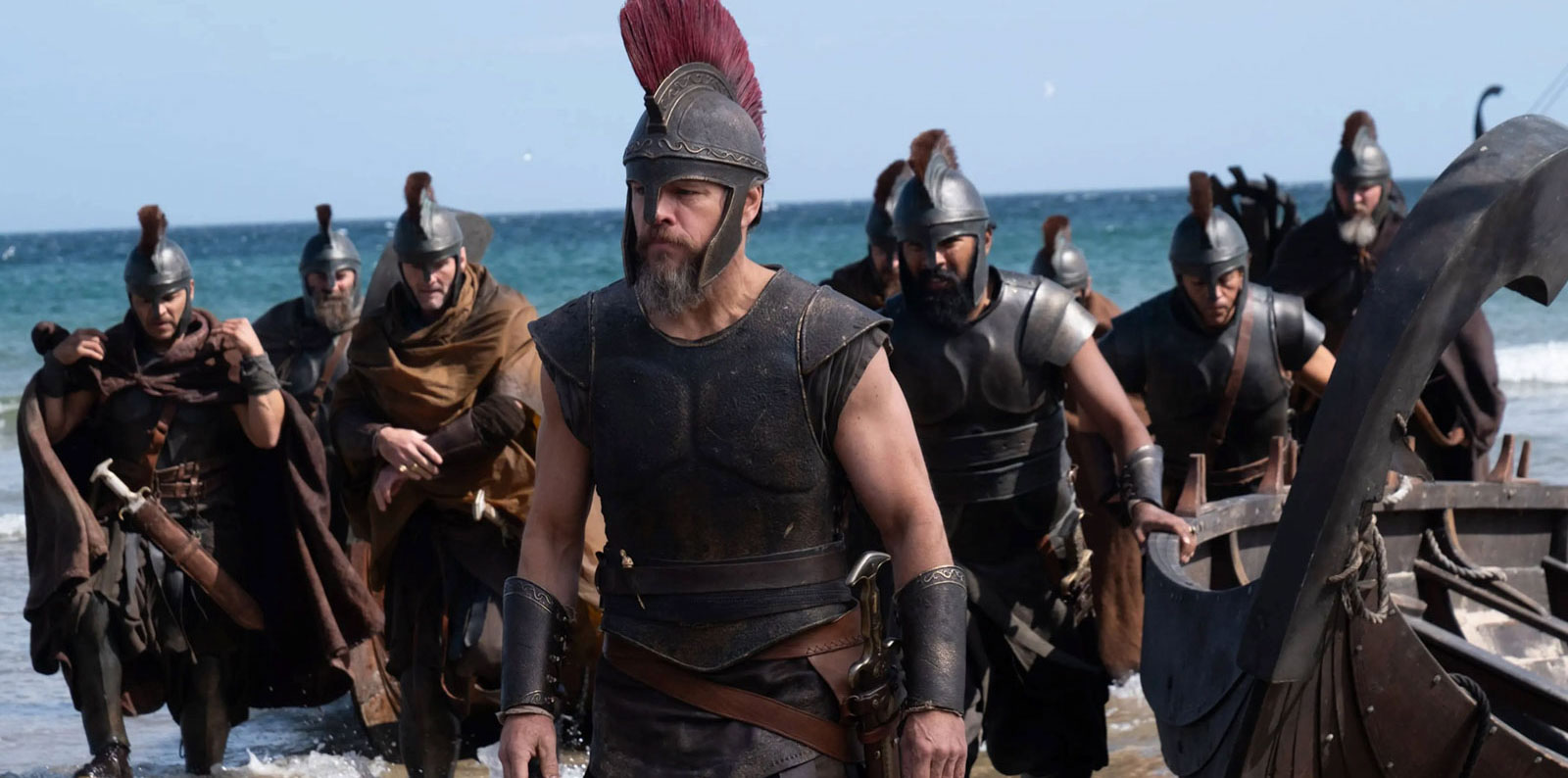
The Odyssey (2026, Dir. Christopher Nolan):
SPEAK, MEMORY—
Of the cunning hero,
The wanderer, blown off course time and again
After he plundered Troy’s sacred heights.Speak
Of all the cities he saw, the minds he grasped,
The suffering deep in his heart at sea
As he struggled to survive and bring his men home
But could not save them, hard as he tried—
The fools—destroyed by their own recklessness
When they ate the oxen of Hyperion the Sun,
And that god snuffed out their day of return.Of these things,
Speak, Immortal One,
And tell the tale once more in our time.Homer
I’ve been telling this story in all my films for years. It’s a family story, a love story, a revenge story, a war story, a coming-of-age story. It’s a very strong foundational text for me.
Christopher Nolan
The term “classic literature” carries a lot of weight; maybe too much. Say “Shakespeare” and the general public thinks of prestige, formal diction, matters far above us mortals—but people sometimes forget that Shakespeare’s plays, with their mix of the ribald and the lofty, were intended to be accessible for groundlings and royalty alike. The same goes for Homer’s Odyssey: dig under the poetry and the scale, and you’ll find something for everyone, from sea monsters to unabashed romance to apprehensions of fate and the divine. A crowd-pleaser, in short, not unlike the blockbuster movies of today.
Christopher Nolan’s Odyssey mines that same populist vein. His characters speechify with oratorical gusto, then lapse into the plain-spoken vernacular of our day; so, too does the film accommodate both the supernatural and the earthy. “A time of apparent magic,” reads the opening title card, and indeed we get plenty of monsters and magic, but we’re also told of men pissing and shitting themselves inside The Trojan Horse as they await their moment to strike, and any encounters with actual gods tend to be metaphorical or plain hallucinated.
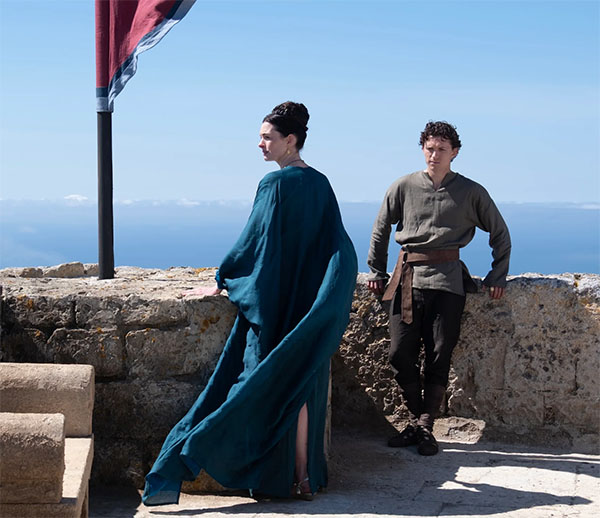
In the main, Nolan’s Odyssey follows Homer’s poem right down to its opening invocation (delivered by Travis Scott—like we said, this Odyssey is for contemporary times): “A face… a fleet… a war… a man… a thought… a trick… a trick to break the walls of Troy… and burn it screaming to the ground!” To summarize in the manner of Mr. Scott: a king (Odysseus, Matt Damon), a war hero, a trickster (see: Trojan Horse), a decade of obstacles between him and his home of Ithaca, where a lonely queen (Penelope, Anne Hathaway) waits. It’s a classic (there’s that word again) adventure with all the archetypal elements—heroism, cunning, hubris, morality, a touch of the divine—and Nolan dutifully addresses all of them.
The source material’s forward and backward jumps in time are tailor-made for Nolan’s love of chronological tricksiness; he deploys overlapping narratives with more elegance than usual, ping-ponging between Odysseus’s account of his exploits and ominous passages in present-time Ithaca where Penelope fends off ravenous suitors. Weighty matters such as PTSD, guilt, genocide, societal collapse, justice and personal responsibility are touched upon, all under the guise of Zeus’s law of xenia: treat others how you wish to be treated. In this telling, the use of deception and slaughter to end the Trojan War—a clear violation of xenia— has doomed the war’s victors to misfortune and death, a take that situates the film as a companion piece to Nolan’s Oppenheimer, another story about a hero whose cleverness breaks the world.
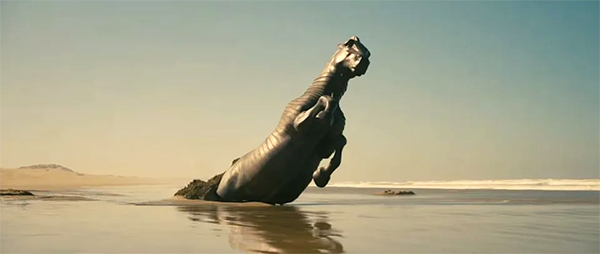
This Odyssey is thus a threnody, shot through with regret, rumination and wrath, and the film’s low-key grandeur matches the tone. We marvel at the Trojan Horse, buried in the beach like the Statue of Liberty in Planet of the Apes, and gasp at the roiling seas Odysseus and his crew must brave (all shot for real—the film’s practical effects are a welcome antidote to today’s CGI), but those wanting DeMille-level spectacle will be disappointed; this is a movie with a cast of a few hundred, not thousands. Nolan places his camera close to his characters, registering expressions rather than grand gestures, and the intimacy often works, especially when Damon is given space to think or react. If he doesn’t quite convince as a wily tactician, his steadfast presence anchors the film’s best moments: a contretemps with a Cyclops that unfolds like a fractured nightmare, an encounter with the witch Circe (Samantha Morton) that’s both horrifying and melancholic, a detour to the black shores of Hades where dead souls are coated in ash.
As always with Nolan, The Odyssey is loaded with exposition to a near-ludicrous degree, with a good half of the film consisting of characters explaining plot points to each other. Some of the actors rise above the clunky dialogue: Robert Pattinson has a ball playing a duplicitous heel vying for Penelope’s hand, while Hathaway hints at layers of steel under her breathy line deliveries. The same can’t be said for Tom Holland’s Telemachus, who passes muster when he’s asked to look pensive but flounders every time he has to explain a new plot development. Still, there’s only so much even Damon can do with a line like “Our age of bronze is collapsing.” No one can say Nolan leaves room for doubt when it comes to Cliff’s Notes.
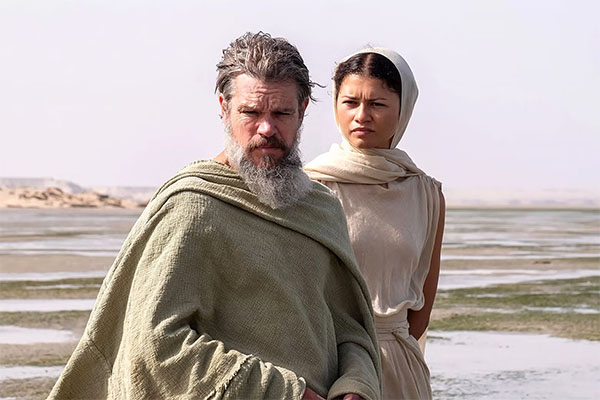
Odysseus: Why can’t gods speak in ways we understand?
Athena: Who doesn’t understand thunder? Fire? A child’s smile? A good harvest?
It’s fascinating to watch Nolan, a clinical director if there ever was one, tackle something as hot-blooded as The Odyssey. For a story steeped in blood and thunder and sex, this Odyssey is oddly bloodless, as soldiers get slashed and smashed left and right without a drop spilled. But for once Nolan’s editing tics—cutaways to characters in other times and places the moment they’re mentioned, the way he stacks up narrative details and then fires off revelations and climaxes—serve the material rather than fight it. Ever the cineaste, he has fun showing off his influences: a little Ray Harryhausen stop animation in the brutish movements of the Cyclops (Bill Irwin), body horror from An American Werewolf in London when Circe turns Odysseus’s men into pigs, a bit of Ingmar Bergman in Odysseus’s dazed, portentous conversations with Calypso (Charlize Theron), filmed amid desolate shores.
More sinewy than poetic, The Odyssey keeps things brisk across its near-three-hour running time, and as a consequence glosses over or ignores a few major aspects of the original. Homer aficionados will find plenty of nits to pick, from the inaccurate period clothing to the film’s refusal to render Zeus or Hermes as actual personages. (Personally, I’m disappointed it skips the emotional climax of the “marriage bed” scene, in which Penelope tests her husband’s identity; one can imagine Hathaway and Damon working some magic with it.) But if every generation gets The Odyssey they deserve, this is a credibly sober take for our sober times, even as it forgoes much of the original’s strangeness and savagery (let’s not speak of Odysseus’s philandering, or the hanging of the housemaidens).
Shortcomings and all, The Odyssey confirms Nolan is one of the best showmen of his generation, even if he tends to tell rather than show. This time out, the true show is the film’s sound design (for all his devotion to IMAX, Nolan seems more preoccupied with sound than cinematographic brio at this point in his career), as every drumbeat, wave crash and Cyclops scream lands with viscera-shaking fidelity. Sound elevates the film’s two tentpole passages: a flashback to the sacking of Troy, camera held low on Odysseus and his men as they swarm like jungle guerillas, Ludwig Göransson’s metallic score swelling to maximum levels of tension, and the moment Odysseus reveals himself to Penelope and her suitors with a single harp-like ping of his bowstring, heralding a finale of Kurosawan chaos that concludes with our hero as a pincushion, blades sticking from his body, much like Toshiro Mifune in Throne of Blood.
“Don’t look for gods in men, you’ll just be disappointed,” says Odysseus. Could Nolan, who wrote the screenplay, be talking about himself? If his Odyssey comes off more mortal than some may desire, it also has the sense not to overstretch, and it concludes with the sunniest ending to a Nolan film since The Dark Knight Rises: a ship sailing toward undying lands, Tolkien-style. “A new dawn will break over the darkened world, when our mistakes will once again be forgotten,” we’re told, even as we watch the Trojan Horse burn in flashback—a nod to the future founding of Rome, or to our own darkened times? To Nolan, history and classic literature always repeat, and in its elegant, elegiac way, The Odyssey reminds us that every civilization has its day in the setting sun. ■
